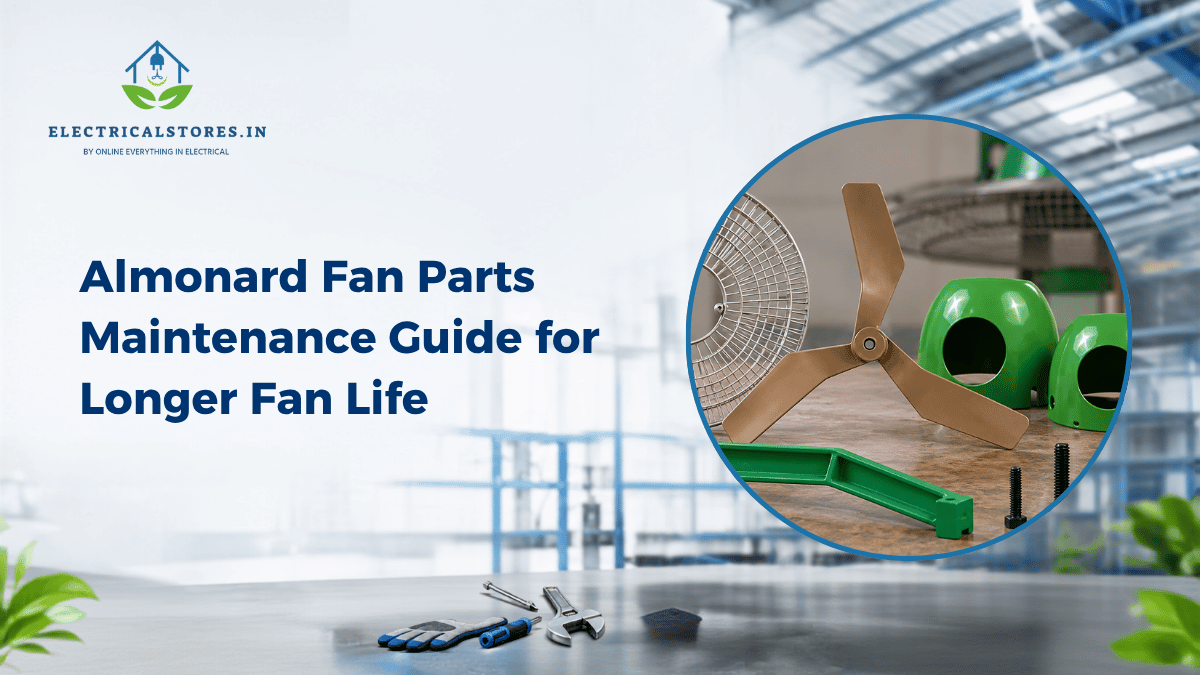
Almonard fans are usually applied in those areas that have industrial, commercial, workshop, warehouse, or any other unfriendly conditions that need constant airflow. The work of all mechanical equipment, their cleaning and maintenance and replacement of the old parts will help maintain the quality of operation and increase the lifetime of the fans.
A proper maintenance system is not limited only by the motor; it is required to inspect from time to time the condition of the fan blades, bearings, grilles, electrical connections, switches, capacitors, fixings, etc.
This Almonard fan parts maintenance guide covers the ways of fan parts maintenance, their possible wear symptoms, and the time for replacement.
Why Is Regular Fan Maintenance Important?
Fans are used for many hours daily. As a result of the continuous exposure to the fan’s working environment, certain effects may occur on various parts.
Regular maintenance can help:
- Maintain consistent airflow
- Reduce unexpected breakdowns
- Identify worn components early
- Reduce unnecessary repair costs
- Improve operating reliability
- Keep the fan cleaner
- Extend the useful life of components
- Downtime reduction
Preventive maintenance is very essential in fans that operate in factory buildings, warehouses, workshops, and commercial settings where ventilation is constantly required.
Important Almonard Fan Parts to Maintain
Different fan components require different maintenance methods. The following areas should be included in a regular inspection routine.
1. Fan Blades
The fan blades affect the air flow. Dust build-up, physical damage, or imbalance can influence fan performance.
Check the blades for:
- Dust and dirt
- Cracks
- Bends
- Loose fittings
- Corrosion
- Unusual vibration
Blades need to be cleaned with the proper method, and there must be no fan blowing with it detached from the electrical source.
If ever it is damaged with cracks and major bends, then the most appropriate thing to do is to replace it rather than repair it.
2. Motor
A motor is one of the essential parts of a fan. Overheating, abnormal sounds, burning smell, and irregular performance may indicate some problems.
During maintenance, check for:
- Excessive overheating
- Unusual noise
- Vibration
- Burning smell
- Reduced speed
- Starting problem
A professional mechanic should conduct an inspection related to the motor when there is a need for electrical tests and servicing.
3. Bearings
Bearings help in making the rotating parts move easily. Old bearings may cause friction and noise.
Signs of possible bearing problems include:
- Grinding sounds
- Increased vibration
- Irregular rotation
- Excessive noise
- Increased motor load
The proper maintenance of the bearings will reduce the chances of causing stress to the motor.
4. Capacitor
In applicable fan models, the capacitor plays an important role in motor starting and operation.
A faulty capacitor may cause symptoms such as:
- Difficulty starting
- Slow fan speed
- Humming
- Reduced performance
- Motor overheating
When these signs are present, the capacitor and motor should be tested instead of replacing parts without testing.
5. Fan Grill
The grill works as a protective covering for the fan assembly but allows air to pass through it.
Keep the grill free from excessive dust and inspect it for:
- Broken sections
- Loose fittings
- Corrosion
- Inappropriate mountings
Grills that are damaged must be changed because they no longer offer appropriate protection.
6. Electrical Connections
Loose or defective wiring may impact fan performance as well as create problems.
It will be important to inspect all the wire connections on a regular basis.
All the wires, connectors, terminals, and switch that are faulty need to be fixed right away.
Never carry out any electrical repairs unless you have the required skills and equipment.
7. Mounting and Support Components
Fans used for industrial and commercial purposes may develop vibrations while operating. Vibrations can be increased by loose mounting elements.
Check:
- Mounting bolts
- Brackets
- Stands
- Fasteners
- Support structures
- Guards
If vibration is still present, tighten the correct bolts according to the manufacturer’s instructions.
Maintenance Guide for Pedestal Fans
Due to the constant movements and adjustments, there is additional stress exerted on the stand, wheels, grills and adjusting systems of pedestal fans.
When maintaining a pedestal fan, check the:
- Fan blades
- Motor
- Front and rear grill
- Height-adjustment mechanism
- Oscillation mechanism
- Stand
- Base
- Switches
- Power cable
In case you are dealing with damaged or worn-out parts, then first look for the almonard pedestal fan spare parts that fit your specific fan model.
Maintenance Guide for Exhaust Fans
The working of exhaust fans is based on the concept of maintaining a steady flow of air within the room or the closed environment. Dust and other particles might accumulate on the blades, grill, and motor of the fan.
For exhaust fan maintenance:
- Switch off and disconnect the power supply.
- Clean the easily accessible surfaces.
- Examine the fan blades.
- Examine the grill and the guard.
- Examine the mounting parts.
- Listen to any unusual sound during running.
- Examine for vibration.
- Get a professional electrical examination if necessary.
Replacement of the fan will require identifying the proper almonard exhaust fan spare parts according to the model of the fan.
How Often Should Almonard Fans Be Maintained?
The best frequency at which the fan can be maintained would depend on the operational environment.
Low Dust Environment
Fans operating in clean environments need to be cleaned and checked periodically.
Industrial Environment
Fans used in factories, workshops, stores and dusty areas have to be maintained regularly.
Continuous Operation
Fans that run for many hours daily must be checked for overheating, vibrations, noise, and performance change.
Preventive maintenance plans may be developed using the time in operation, environment, and manufacturer’s instructions.
Signs That a Fan Part Needs Replacement
Maintenance does not just mean clean. It also includes identifying which parts have come to the end of their functional life cycle.
Consider professional inspection when you notice:
- Fan speed has reduced
- Airflow has become weaker
- Motor frequently overheats
- Fan produces unusual sounds
- Excessive vibration occurs
- Blades are damaged
- Bearings are noisy
- Grill or guard is broken
- Fan does not start reliably
- Damages can be noticed in electrical parts
A damaged component that is replaced in good time can prevent damage to other components.
Cleaning Tips for Longer Fan Life
Just the cleaning itself is enough to make the whole difference.
Before cleaning, switch off the electricity supply: It should not be carried out when the fan is still working.
Clean the fan regularly: Too much dust buildup may impede airflow, thus making the fan overheat.
Do not use water: It should not come into contact with the electrical part of the fan.
Check the loose parts: Anything that moves oddly needs to be checked.
Don’t clutter the environment: Cluttering causes obstruction in air circulation.
Strange noises: Never ignore any unusual noise coming from the fan.
How to Choose Replacement Parts
When buying almonard fan parts replacements, do not choose a part simply based on its looks.
Provide the supplier with:
- Fan model number
- Existing part details
- Part dimensions, where applicable
- Motor specifications
- Photos of the damaged component
- Required quantity
The data will help you decide on the right replacement to avoid any problems of compatibility.
Frequently Asked Questions
How can I increase the life span of my Almonard fan?
Through cleaning, preventive maintenance tests, correct installation, timely replacement of the old parts, and avoiding overheating of the fan, its life span will be increased.
Which Almonard fan components require regular maintenance?
The fan blades, motor, bearings, grills, capacitors, electric connection, mounts, and other moving or exposed parts should be maintained regularly.
How do I know that the blades of a fan need to be replaced?
Cracked blades, bent blades, corroded blades, unbalanced blades or any other damage of the blades should be a signal that the blades should be replaced.
Why is my Almonard fan making an unusual noise?
The possible reasons could be worn-out bearings, loose fittings, imbalanced blades, problems with the motor, etc. An expert inspection will help to understand the true cause.
Can I able to clean my Almonard fan by myself?
Basic cleaning from the outside is possible after disconnecting the power source. However, any electrical and motor maintenance should be carried out by a professional technician.
Conclusion
Proper maintenance is probably the easiest way to ensure that the Almonard fan functions properly. This includes cleaning the blades and grills, inspecting the motor and bearings, electrical connections, and vibration of the system, as well as replacing parts as necessary.
What is important here is that the problem should be detected at an early stage. Rather than waiting for the whole fan to fail, it is always better to carry out preventive maintenance. Always ensure that you have the right specifications when replacing any parts of your fan
